
‘Reward for failure’: Investor support for Target Chair Brian Cornell falls to lowest level ever
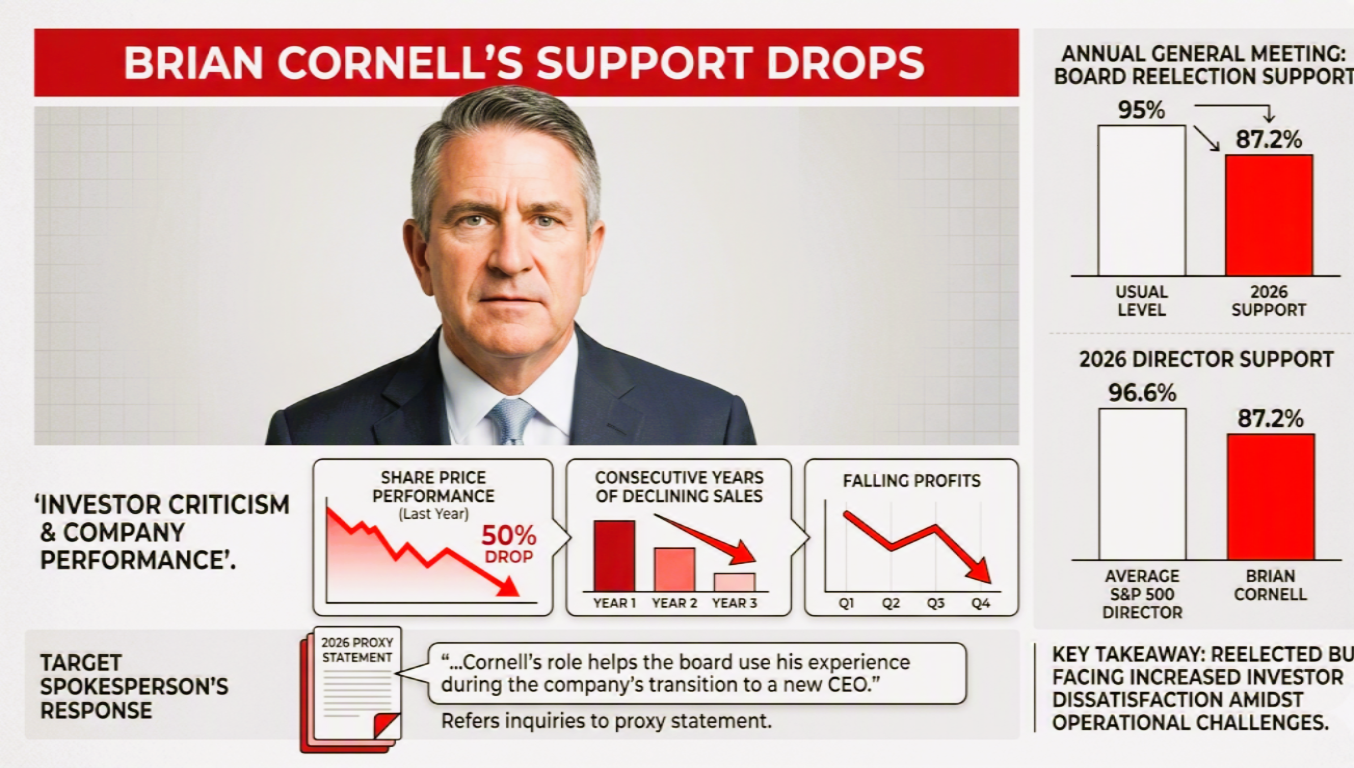
Brian Cornell, who is the executive chairman and former CEO of Target, was reelected to the company’s board of directors.However, during the recent annual general meeting, there was a noticeable drop in support from investors.His support dropped to 87.2%, which is lower than his usual level of around 95%.This is also below the average support that directors in the S&P 500 have received this year, which is about 96.6%.
Cornell has come under criticism for leading the company through a 50% drop in share price, three consecutive years of declining sales, and falling profits.
A spokesperson for Target did not comment to CNBC and instead pointed to the 2026 proxy statement.In that document, it says that Cornell’s role helps the board use his experience during the company’s transition to a new CEO.
Target has promised investors that it’s pursuing an aggressive turnaround with a new CEO at the helm, but its longtime former top executive Brian Cornell still leads the retailer’s board of directors — and some major investors are signaling they’re hungry for change.
Shareholder backing for Target’s former CEO and current Executive Chairman Cornell fell to its lowest level ever during the company’s annual general meeting this month.
While Cornell, 67, was comfortably reelected to his position on Target’s board of directors, he saw the steepest drop in support since he joined the retailer’s board more than a decade ago, when he was hired as its CEO.
In all, 87.2% of shareholders voted to reelect him to the board — a 4% decline from the year-ago period and a material drop from his historical average of 95% support. It’s also well below the average level of support directors have received across the S&P 500 this year, which Harvard Law puts at 96.6%.
“Achieving a great score above 95% is typical. that’s what Scoring below 95% is deemed inadequate, while anything under 90% is classified as extremely unsatisfactory. It implies that individuals are intentionally indicating they no longer wish for your presence,” remarked Kevin Kaiser, an adjunct full professor of finance at The Wharton School of the University of Pennsylvania, who leads a course on shareholder activism.
Considering how many investors routinely endorse the recommendations made by major proxy firms or boards, “a score below 90 is perceived as a very unfavorable outcome” and is seldom witnessed, Kaiser explained.
Cornell’s decrease in backing follows his resignation from the position of CEO and his transition to become Target’s executive chairman in February, as the company faced declining profits and a dropping share price.
Critiquing Cornell
Since joining Target as the retailer’s CEO in 2014, Cornell grew sales by more than 44% and helped transform it into a $100 billion-plus juggernaut as he oversaw the expansion of its digital presence, grew stores and steered the company through the Covid-19 pandemic.
But over the past few years, he’s faced rising criticism as the company has underperformed expectations and lost share to competitors like Costco, Walmart and Amazon. Target has been criticized for mismanaging inventory, under-investing in stores and falling behind on the trendy, eye-catching merchandise the retailer built its name on.
Target has also been the subject of backlash over its actions on a number of social justice issues, and the brunt of that has fallen on Cornell. The retailer reduced certain LGBTQ-themed pride merchandise in stores several summers ago and rolled back diversity, equity and inclusion programs, which led to nationwide boycotts and preceded weeks of foot traffic declines.
There is some Combined, these issues have contributed to a precipitous drop in Target’s share price, which is up about 33% year to date but still down by roughly 50% since its all-time high in 2021.
When the company announced as the news of that Cornell would be stepping down as CEO in February, Wall Street had favored an outside candidate to succeed him, according to a June 2025 survey of 51 investors by Mizuho Securities, an equity research firm.
When it said two insiders would continue to lead the company — Cornell as executive chair and company veteran Fiddelke as CEO— the same day that it forecast another annual sales decline, investors were disappointed, leading shares to fall. However, since then, it appears as if analysts and investors are warming up to Fiddelke, who received 99% of the vote during the company’s meeting.
“It feels like they’re doing a lot of things better in terms of merchandising,” Michael Baker, a senior research analyst at investment bank D.A. Davidson, said in an interview. “To me that would be a sign of continued progress under Michael Fiddelke.”
During the company’s fiscal first quarter, which ended May 2, Target saw comparable sales grow 5.6% — its first positive same-store sales number in five quarters, with strength across all six of its core merchandising categories. While Target said its turnaround efforts are showing signs of early progress, finance chief James Lee acknowledged higher tax refunds helped to fuel spending, a benefit he expects to fade over the rest of the year.